
Atrium Service
Atrium Smoke Control CFD Analysis
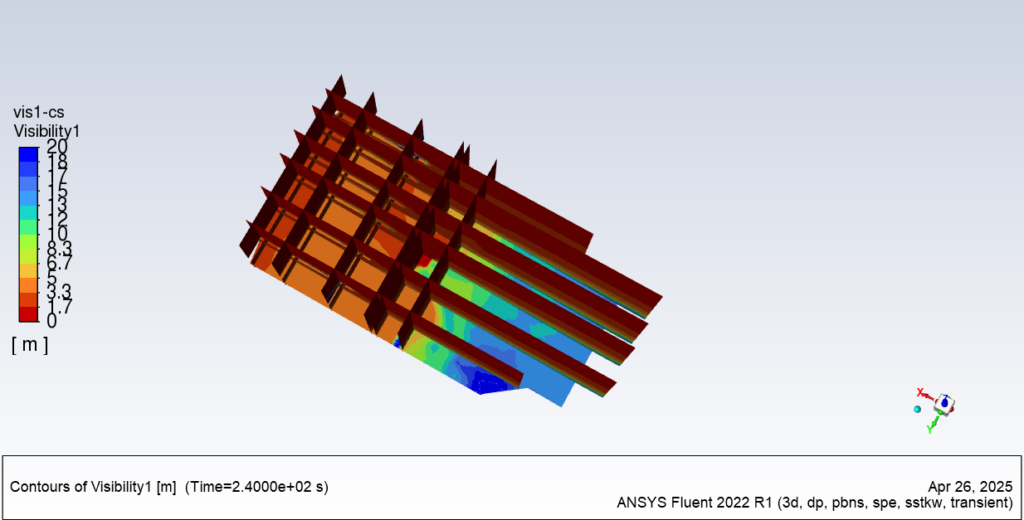
Atriums are large open spaces within a building that often serve as common areas, lobbies, or meeting places. In the event of a fire, smoke control becomes crucial to ensure the safety of occupants and facilitate effective evacuation. CFD analysis allows engineers to understand and predict the movement of smoke within an atrium, enabling them to design and implement efficient smoke control strategies.
When performing a CFD analysis for smoke control in an atrium, the following steps are typically followed:
- Geometry Creation: The atrium’s geometry, including its architectural features, ventilation openings, and smoke extraction systems, is modeled using specialized software.
- Mesh Generation: A computational mesh is created over the atrium’s geometry, dividing it into small computational cells. This mesh discretizes the domain and facilitates the calculation of fluid flow and smoke movement within the atrium.
- Numerical Solver: The CFD software solves the governing equations for fluid flow and smoke dispersion, such as the Navier-Stokes equations and the conservation of mass, momentum, and energy. These equations are solved iteratively to predict the fluid flow patterns and smoke behavior within the atrium.
- Smoke Control Evaluation: Once the CFD simulation is complete, engineers analyze the results to assess the effectiveness of smoke control measures. This evaluation includes parameters such as smoke concentration, temperature distribution, and airflow patterns.
An example of CFD analysis for smoke control in an atrium in a Gulf country involved studying the considered factors like the atrium’s geometry, smoke extraction systems, and ventilation openings. By simulating various fire scenarios and evaluating different smoke control strategies, RIA optimized the design of smoke management systems, such as smoke extraction fans, pressurization techniques, and smoke barriers, to ensure the safety of occupants in the event of a fire.