CFD ANALYSIS FOR HEAT EXCHANGERS
CFD Analysis Services for Heat Exchangers: Improving Thermal Performance and Design Efficiency
Heat exchangers are critical components in many industrial systems, including power plants, oil and gas facilities, chemical processing plants, and HVAC systems. Their primary function is to transfer heat efficiently between two or more fluids while maintaining operational reliability and energy efficiency.
Computational Fluid Dynamics (CFD) analysis provides an advanced engineering approach for evaluating fluid flow behavior and heat transfer performance within heat exchanger systems. Through detailed CFD simulations, RIA GULF helps engineers and facility operators analyze heat exchanger performance, identify inefficiencies, and optimize designs to improve thermal efficiency.
Introduction to CFD Analysis for Heat Exchangers
Computational Fluid Dynamics (CFD) is a powerful numerical simulation technique used to analyze fluid flow, heat transfer, and thermal interactions in complex systems.
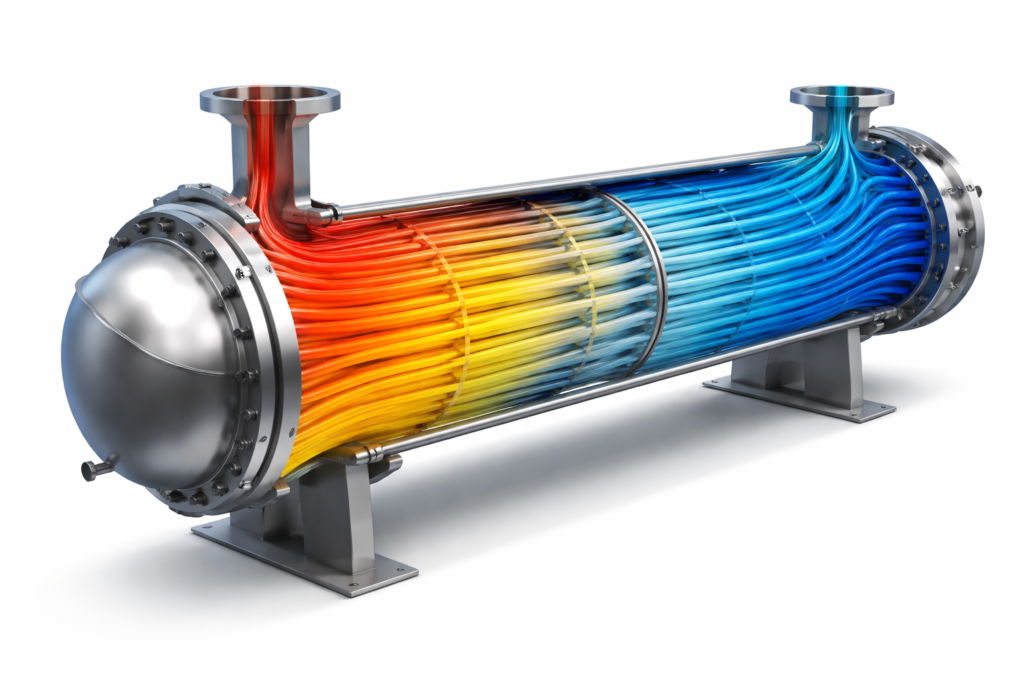
In heat exchanger applications, CFD simulations allow engineers to study the interaction between flowing fluids and heat transfer surfaces. These simulations provide valuable insights into:
Flow distribution within heat exchanger channels
Heat transfer efficiency between fluid streams
Temperature distribution across heat exchange surfaces
Pressure losses within the system
Potential areas of flow maldistribution or stagnation
By accurately modeling these processes, engineers can better understand the performance of heat exchangers and implement design improvements.
RIA GULF’s Expertise in Heat Exchanger CFD Analysis
RIA GULF provides specialized CFD simulation services for evaluating and optimizing heat exchanger performance. With strong expertise in fluid mechanics, heat transfer modeling, turbulence analysis, and thermal system design, the company supports engineering consultants, plant operators, and equipment manufacturers.
RIA GULF’s CFD studies help clients understand complex thermal and flow interactions within heat exchangers, enabling informed engineering decisions during both the design and operational phases.
Optimizing Heat Transfer Performance
Efficient heat transfer is essential for the performance of heat exchangers. Poor flow distribution or inefficient heat transfer surfaces can significantly reduce system performance and increase energy consumption.
Using CFD simulations, RIA GULF evaluates:
Flow patterns within heat exchanger channels
Temperature distribution across heat transfer surfaces
Influence of geometry on heat transfer efficiency
Thermal performance under different operating conditions
Effect of fluid properties on heat exchange performance
These analyses help engineers optimize heat exchanger designs to maximize thermal efficiency.
Evaluating Pressure Drop and Flow Distribution
In addition to heat transfer performance, pressure drop across the heat exchanger is an important design consideration. Excessive pressure losses can reduce system efficiency and increase pumping power requirements.
CFD analysis performed by RIA GULF helps assess:
Pressure distribution across the heat exchanger
Flow maldistribution between channels or tubes
Recirculation zones affecting performance
Influence of internal components on fluid flow
Understanding these factors allows engineers to balance heat transfer performance with acceptable pressure drop levels.
Supporting Design Optimization and Performance Improvement
CFD analysis allows engineers to evaluate multiple design configurations and operating conditions before implementing physical changes. This reduces the need for costly trial-and-error testing and accelerates the design process.
RIA GULF supports heat exchanger projects by helping engineers:
Improve thermal efficiency of existing systems
Optimize internal flow paths and geometries
Evaluate different operating conditions
Identify performance limitations in current designs
These insights contribute to improved system reliability and enhanced operational efficiency.
Enhancing Thermal Systems Through Advanced Simulation
By combining advanced CFD modeling techniques with expertise in heat transfer and fluid dynamics, RIA GULF helps engineers optimize heat exchanger performance across a wide range of industrial applications.
Through detailed simulations of fluid flow and heat transfer processes, engineers can identify inefficiencies, evaluate design improvements, and ensure that heat exchangers operate at optimal performance levels.