CFD ANALYSIS FOR INDOOR SHOOTING RANGES
CFD Analysis Services for Indoor Shooting Ranges: Ensuring Safe Ventilation and Air Quality
Indoor shooting ranges require carefully designed ventilation systems to maintain safe air quality for shooters, instructors, and facility staff. During firearm discharge, contaminants such as smoke particles, combustion gases, and lead-containing aerosols can accumulate within the shooting environment if airflow is not properly controlled.
Computational Fluid Dynamics (CFD) analysis provides an advanced engineering method to evaluate airflow behavior and contaminant transport within indoor shooting ranges. Through detailed CFD simulations, RIA GULF helps engineers and facility designers optimize ventilation systems to ensure effective contaminant removal and maintain safe breathing conditions for occupants.
Introduction to CFD Analysis for Indoor Shooting Ranges
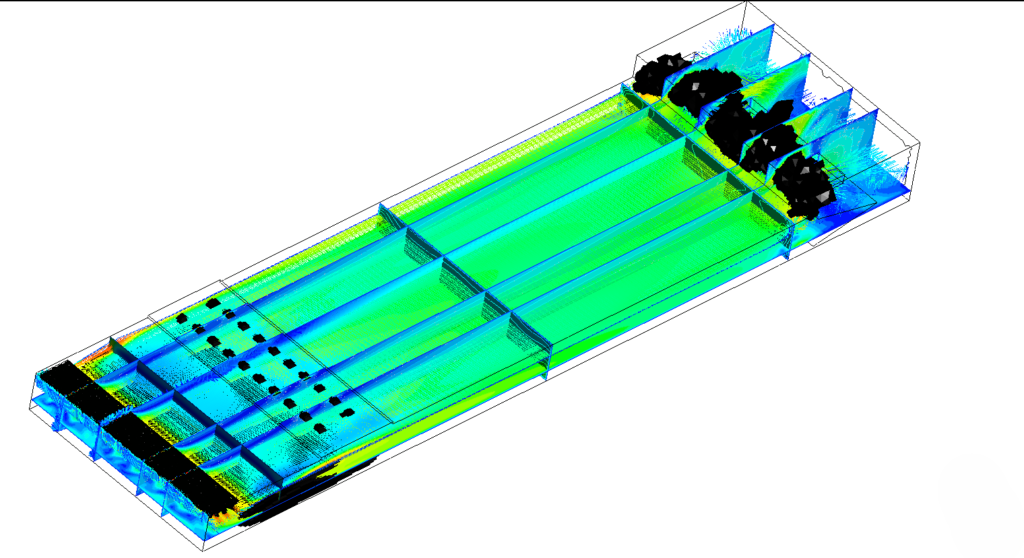
Computational Fluid Dynamics (CFD) is a numerical simulation technique used to analyze airflow patterns, particle transport, and ventilation performance within enclosed environments.
In indoor shooting ranges, CFD simulations help evaluate how air moves through the range and how airborne contaminants are transported and removed by ventilation systems. These simulations provide valuable insights into:
Airflow distribution within the shooting range
Transport and dispersion of airborne contaminants
Ventilation effectiveness in removing smoke and particles
Pressure distribution between firing line and adjacent spaces
Performance of supply and exhaust ventilation systems
By accurately simulating airflow behavior, engineers can design ventilation systems that maintain safe air quality and meet health and safety standards.
RIA GULF’s Expertise in Shooting Range Ventilation CFD Analysis
RIA GULF provides specialized CFD simulation services for evaluating ventilation performance in indoor shooting ranges. With strong expertise in fluid dynamics, indoor air quality analysis, contaminant transport modeling, and mechanical ventilation systems, the company supports architects, facility designers, and range operators in developing safe and efficient range environments.
RIA GULF’s CFD studies help ensure that ventilation systems are properly designed to maintain controlled airflow from the shooter area toward the bullet trap while effectively removing airborne contaminants.
Optimizing Ventilation System Design
Proper ventilation design is critical for maintaining safe conditions within indoor shooting ranges. A well-designed airflow system ensures that contaminants are continuously directed away from occupants and safely removed through exhaust systems.
Using CFD simulations, RIA GULF evaluates key ventilation parameters such as:
Air supply diffuser placement and airflow direction
Exhaust ventilation system performance
Airflow velocity across the firing line
Recirculation zones and stagnant air regions
Contaminant transport toward exhaust outlets
These simulations allow engineers to optimize ventilation design and ensure that airflow moves consistently from the shooter area toward the backstop.
Maintaining Safe Indoor Air Quality
Indoor shooting activities generate airborne contaminants that must be effectively controlled to protect the health of range users and staff. CFD analysis helps engineers evaluate whether ventilation systems provide sufficient airflow to dilute and remove contaminants.
Through CFD simulations, RIA GULF can assess:
Contaminant concentration levels within the range
Airflow velocity at the firing line
Effectiveness of contaminant removal systems
Distribution of smoke and airborne particles
These insights support the design of ventilation systems that maintain safe air quality and improve the overall operational safety of the facility.
Compliance with Safety and Ventilation Guidelines
Indoor shooting ranges must comply with strict ventilation and air quality guidelines established by safety authorities and regulatory organizations. CFD analysis provides a scientific and reliable approach for evaluating whether ventilation systems meet these performance requirements.
RIA GULF supports project teams by conducting CFD studies that assist in demonstrating compliance with applicable ventilation standards and safety guidelines for indoor shooting facilities.
Enhancing Safety Through Advanced Simulation
By combining advanced CFD modeling techniques with expertise in ventilation and air quality analysis, RIA GULF helps designers develop effective ventilation systems that enhance safety in indoor shooting ranges.
Through detailed airflow and contaminant transport simulations, engineers can evaluate different ventilation configurations, identify potential airflow issues, and ensure that shooting range facilities maintain safe and controlled operating conditions.