CFD Analysis of Data Center Cooling Performance
INTRODUCTION
Data centers are the backbone of modern digital infrastructure, housing critical IT equipment that generates significant amounts of heat during operation. Efficient cooling is essential to maintain optimal performance, prevent equipment failure, and ensure energy efficiency.
Traditional cooling design methods often rely on rule-of-thumb approaches and simplified calculations. However, with increasing rack densities and complex layouts, these methods may not accurately capture airflow behavior and temperature distribution.
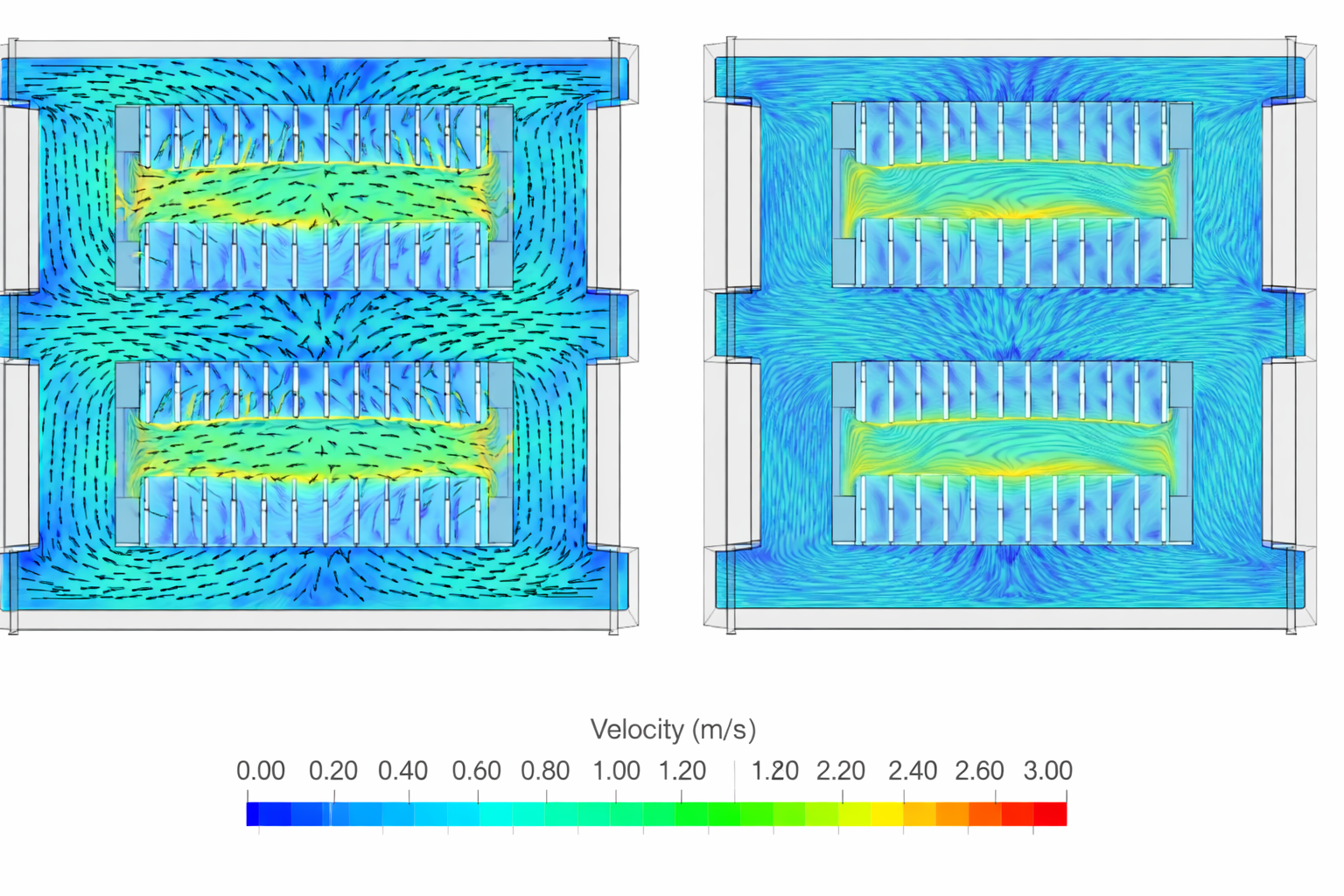
Computational Fluid Dynamics (CFD) provides a powerful tool to simulate airflow, heat transfer, and cooling performance within data centers. By modeling real operating conditions, CFD helps engineers design optimized cooling systems that improve reliability and reduce energy consumption.
Thermal Management Challenges in Data Centers
Modern data centers present several cooling challenges:
- High heat loads from densely packed servers
- Hot aisle and cold aisle mixing
- Uneven airflow distribution
- Recirculation of hot air
- Presence of cable trays, racks, and obstructions
- Increasing demand for energy-efficient cooling systems
These factors can lead to hotspots, inefficient cooling, and increased operational costs.
Role of CFD in Data Center Cooling Design
CFD simulations solve governing equations of fluid flow and heat transfer to predict cooling performance.
In data centers, CFD is used to:
- Analyze airflow distribution across server racks
- Identify hotspots and thermal inefficiencies
- Evaluate cooling effectiveness of CRAC/CRAH units
- Study hot aisle and cold aisle containment strategies
- Optimize placement of perforated tiles and vents
- Assess impact of rack layout and equipment density
By visualizing temperature contours and airflow patterns, CFD enables engineers to make informed design decisions before implementation.
Geometry and Domain Setup
The computational domain typically includes:
- Server racks and cabinets
- Raised floor or overhead plenum
- CRAC/CRAH units
- Perforated tiles or diffusers
- Cable trays and structural elements
Accurate geometry representation is essential to capture realistic airflow paths and obstructions.
Mesh Generation
The domain is discretized into control volumes for numerical analysis.
Mesh refinement is applied near:
- Server racks (high heat zones)
- Air supply vents and return paths
- Cooling units
- Occupied zones and critical equipment areas
A high-quality mesh ensures accurate prediction of temperature gradients and airflow behavior.
Heat Load Modelling
Each server rack is assigned a heat load based on power consumption:
- Sensible heat generation from IT equipment
- Non-uniform heat distribution across racks
- High-density rack scenarios
This allows realistic simulation of thermal loads within the data center.
Airflow and Cooling Modelling
CFD models incorporate:
- Supply air temperature and velocity
- Airflow through perforated tiles
- Return air pathways
- Turbulence models for realistic flow behavior
This helps evaluate how effectively cool air reaches servers and removes heat.
Performance Metrics Used
We evaluated six key performance indices:
- Supply Heat Index (SHI) & Return Heat Index (RHI) – Measure supply air utilization and heat extraction efficiency.
- Return Temperature Index (RTI) – Indicates effectiveness in managing hot air recirculation and cold air bypass.
- Beta Index (β) – Assesses airflow utilization.
- Energy Utilization Coefficient (ηᵣ) – Evaluates thermal efficiency.
- Index of Mixing (IOM) – Indicates the extent of hot and cold air mixing.
Advantages of CFD-Based Data Center Analysis
CFD offers several benefits:
- Detailed visualization of airflow and temperature fields
- Early detection of cooling inefficiencies
- Optimization of cooling system design
- Reduction in energy consumption and operational cost
- Improved reliability and equipment lifespan
- Support for high-density and future-ready designs
Conclusion
CFD analysis has become an essential tool in modern data center design and operation. By simulating airflow patterns, temperature distribution, and cooling performance, CFD enables engineers to optimize thermal management strategies effectively.
As data centers continue to grow in complexity and scale, CFD-driven analysis will play a critical role in ensuring energy efficiency, operational reliability, and sustainable infrastructure development.