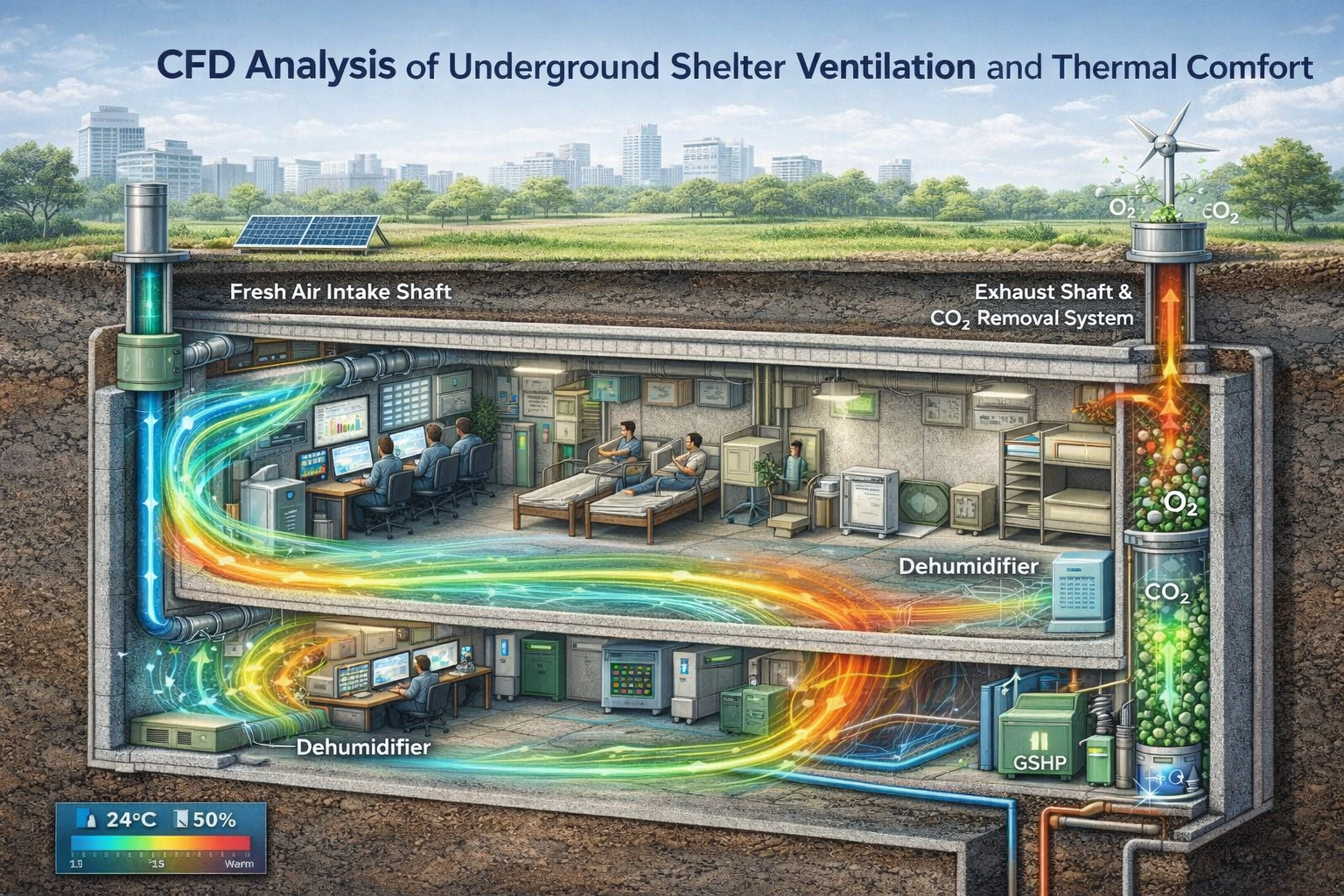
CFD Analysis of Underground Shelter Ventilation and Thermal Comfort
INTRODUCTION
Underground shelters are increasingly used in civil defense, emergency planning, and sustainable infrastructure. While these structures provide protection and thermal stability, they also introduce significant challenges in ventilation, humidity control, and thermal comfort.
Unlike conventional buildings, underground shelters operate in confined environments with limited airflow and high moisture levels. Ensuring a safe and comfortable indoor environment requires advanced HVAC strategies.
Computational Fluid Dynamics (CFD) plays a critical role in analyzing airflow behavior, temperature distribution, and ventilation efficiency in such environments. By simulating real operating conditions, CFD helps engineers design optimized systems that enhance safety, comfort, and energy efficiency.
Thermal and Ventilation Challenges in Underground Shelters
Underground shelters face unique environmental challenges:
- Limited natural airflow and stagnant air zones
- High humidity levels (often exceeding 70–80%)
- Heat accumulation due to occupant density
- Poor air distribution in confined spaces
- Risk of CO₂ buildup and reduced oxygen levels
- Condensation and moisture-related structural issues
These factors can lead to discomfort, health risks, and reduced system efficiency if not properly managed.
Role of CFD in Underground HVAC Design
CFD provides a powerful approach to simulate and optimize underground environments.
In underground shelter design, CFD is used to:
- Analyze airflow distribution through shafts and tunnels
- Evaluate ventilation efficiency and air exchange rates
- Predict temperature and humidity distribution
- Optimize placement of inlets, outlets, and shafts
- Study impact of airflow velocity, angle, and patterns
- Improve indoor air quality and occupant comfort
CFD enables visualization of velocity vectors, temperature contours, and airflow paths, allowing engineers to make data-driven design decisions before implementation.
Ventilation Strategies in Underground Shelters
- Passive Ventilation Systems
Passive ventilation relies on natural forces such as:
- Wind Pressure
- Thermal buoyancy
Key design features include:
- Vertical shafts
- Cross-ventilation corridors
- Pressure-driven airflow systems
Studies show that optimized shaft configurations can improve airflow performance by up to 18%, enhancing air circulation without mechanical energy input.
However, passive systems are limited in hot and humid climates due to moisture ingress.
- Hybrid Ventilation Systems
Hybrid systems combine:
- Natural ventilation
- Mechanical systems
- Renewable energy integration
Examples include:
- Solar chimneys
- Photovoltaic/Thermal (PVT) systems
- Ground Source Heat Pumps (GSHP)
These systems can reduce HVAC energy consumption by approximately 23% while maintaining thermal stability.
Hybrid systems are essential for maintaining performance under varying environmental conditions.
CFD Modelling of Underground Shelters
Geometry and Domain Setup
The computational domain typically includes:
- Shelter tunnels and chambers
- Ventilation shafts
- Air inlets and outlets
- Occupied zones
- Surrounding soil domain
Accurate representation is crucial to capture real airflow behaviour.
Mesh Generation
The domain is discretized into control volumes for numerical analysis.
Mesh refinement is applied near:
- Air supply and exhaust points
- Occupied zones
- High heat regions
- Narrow passages
A high-quality mesh ensures accurate prediction of temperature gradients and airflow behavior.
Boundary Conditions and Heat Loads
CFD models incorporate:
- Air velocity and temperature at inlets
- Heat generation from occupants and equipment
- Soil thermal interaction
- Humidity and moisture transport
This allows realistic simulation of underground conditions.
Key Performance Metrics in CFD Analysis
CFD analysis evaluates several critical performance indicators:
- Air velocity and airflow uniformity
- Temperature distribution
- Relative humidity levels
- CO₂ concentration
- Predicted Mean Vote (PMV) and thermal comfort
- Predicted Percentage of Dissatisfied (PPD)
- Air age and ventilation effectiveness
For optimal comfort, standards recommend:
- PMV between -0.5 and +0.5
- PPD below 10%
- CO₂ levels below 1000 ppm
- Thermal Comfort and Humidity Control
One of the biggest challenges in underground shelters is humidity.
Key observations
- Temperature remains relatively stable (21–27°C)
- Humidity often exceeds 70–80%
- High humidity reduces comfort and causes condensation
Effective strategies include:
- Mechanical dehumidification
- Controlled airflow distribution
- Vapor barriers and waterproofing
- Dedicated outdoor air systems (DOAS)
Humidity control is as important as temperature control in underground environments.
Energy-Efficient HVAC Strategies
Modern underground HVAC systems focus on energy efficiency:
- Ground Source Heat Pumps reduce energy use by up to two-thirds
- Thermal energy storage (PCM systems) enables emergency cooling
- Air intake tunnels act as natural heat exchangers
- Smart sensors optimize system performance
- Seasonal temperature control strategies can reduce energy consumption by up to 59%.
- Safety and Life-Support Considerations
Underground shelters must ensure occupant safety during long-duration isolation.
Key requirements:
- Continuous oxygen supply
- CO₂ removal systems
- Redundant ventilation systems
- Air purification (HEPA, filtration systems)
Advanced Systems include:
- Electrolysis-based oxygen generation
- CO₂ scrubbing using chemical or regenerative methods
- Closed-loop air management systems
These systems transform HVAC into a life-support system, not just a comfort system.
Advantages of CFD-Based Underground Analysis
CFD offers several advantages:
- Detailed visualization of airflow and thermal behavior
- Early detection of design issues
- Optimization of ventilation strategies
- Improved energy efficiency
- Enhanced occupant safety and comfort
- Reduced operational and lifecycle costs
Conclusion
CFD analysis has become an essential tool for designing HVAC systems in underground shelters. By accurately predicting airflow, temperature, and humidity behavior, CFD enables engineers to develop efficient, safe, and sustainable solutions.
The integration of passive ventilation, hybrid systems, renewable energy, and intelligent controls is key to achieving optimal performance.
As underground infrastructure continues to grow, CFD-driven design will play a crucial role in ensuring:
- Thermal comfort
- Energy efficiency
- Environmental sustainability
- Long-term operational reliability