
CFD ANALYSIS FOR OUTDOOR COOLING
CFD Analysis Services for Outdoor Cooling: Improving Thermal Comfort in Outdoor Environments
Outdoor spaces in hot climates often experience extremely high temperatures, making thermal comfort a major challenge for occupants. In regions such as the Gulf countries, where summer temperatures can exceed 45°C, outdoor cooling strategies are increasingly used in public spaces, industrial facilities, and commercial developments to improve comfort and usability.
Computational Fluid Dynamics (CFD) analysis provides an advanced engineering method for studying airflow patterns, temperature distribution, and cooling effectiveness in outdoor environments. Through detailed CFD simulations, RIA GULF helps engineers and project developers design outdoor cooling systems that reduce heat exposure and improve thermal comfort in open or semi-open spaces.
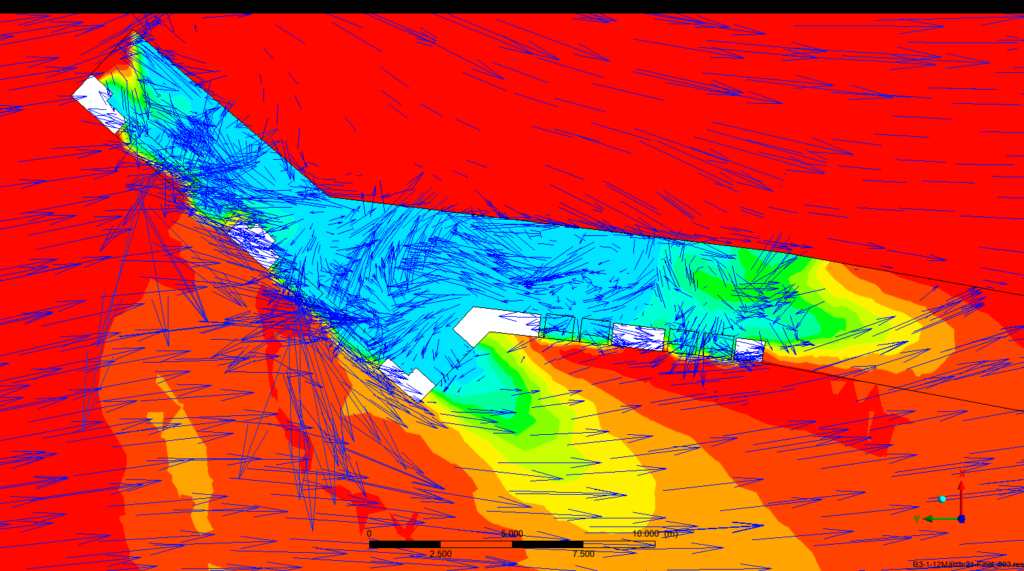
Introduction to CFD Analysis for Outdoor Cooling
Computational Fluid Dynamics (CFD) is a powerful simulation technique used to analyze fluid flow and heat transfer within complex environments. In outdoor cooling applications, CFD simulations allow engineers to evaluate how air movement, cooling sources, and environmental conditions interact to influence thermal comfort.
CFD analysis helps evaluate:
Airflow patterns in outdoor spaces
Temperature distribution within pedestrian zones
Interaction between cooling air and ambient wind
Performance of outdoor cooling systems
Heat dispersion from surrounding surfaces and structures
By simulating real environmental conditions, engineers can design cooling strategies that effectively reduce heat buildup in outdoor environments.
RIA GULF’s Expertise in Outdoor Cooling CFD Analysis
RIA GULF provides specialized CFD simulation services for evaluating outdoor cooling solutions in hot climates. With strong expertise in fluid dynamics, heat transfer modeling, and environmental airflow analysis, the company supports architects, engineers, and developers in designing comfortable outdoor spaces.
RIA GULF’s CFD studies help assess how cooling strategies perform under realistic environmental conditions, allowing project teams to optimize system design before implementation.
Evaluating Outdoor Cooling Strategies
Various technologies are used to reduce heat in outdoor environments, including evaporative cooling systems, chilled air supply, shading structures, and misting systems. The effectiveness of these systems depends heavily on airflow behavior and environmental conditions.
Using CFD simulations, RIA GULF evaluates:
Air distribution from outdoor cooling units
Effectiveness of evaporative cooling systems
Influence of shading structures on heat reduction
Interaction between cooling air and ambient wind
Cooling effectiveness within pedestrian areas
These analyses help engineers determine the most effective cooling solutions for specific outdoor environments.
Improving Thermal Comfort in Public and Industrial Spaces
Outdoor cooling systems are commonly used in a variety of environments including commercial developments, transportation hubs, and industrial facilities. Proper design of these systems can significantly improve comfort levels for occupants.
CFD analysis conducted by RIA GULF helps evaluate cooling performance in spaces such as:
Outdoor courtyards and plazas
Industrial work areas
Outdoor dining areas
Building entrances and pedestrian walkways
Semi-enclosed outdoor environments
These studies provide valuable insights that help designers create outdoor spaces that remain comfortable even during extreme heat conditions.
Considering Environmental and Wind Effects
Outdoor cooling performance is strongly influenced by environmental conditions such as wind speed, solar radiation, and surrounding building geometry. These factors can significantly impact how cooling air spreads and how heat accumulates in outdoor spaces.
CFD simulations enable engineers to study:
Ambient wind interaction with cooling systems
Heat buildup caused by surrounding structures
Air recirculation zones in outdoor areas
Impact of urban geometry on airflow patterns
Understanding these environmental effects allows designers to implement more effective cooling strategies.
Enhancing Outdoor Environments Through Advanced Simulation
By combining advanced CFD modeling techniques with expertise in environmental airflow analysis, RIA GULF helps project teams design outdoor cooling systems that improve thermal comfort and usability of outdoor spaces.
Through detailed simulations of airflow and temperature distribution, engineers can optimize cooling system placement, evaluate design alternatives, and ensure that outdoor environments remain comfortable even in challenging climatic conditions.