Turbine Blade Design, Aerodynamic Modelling & Optimization Services
CFD Analysis Services for Turbine Blade Aerodynamic Modelling and Performance Optimization
Modern gas turbines and steam turbines operate under demanding aerodynamic conditions where blade performance directly influences efficiency, power output, and operational reliability. Turbine blade aerodynamic modelling plays a critical role in the design, analysis, and optimization of blade profiles to achieve improved flow characteristics, reduced losses, and enhanced turbine performance.
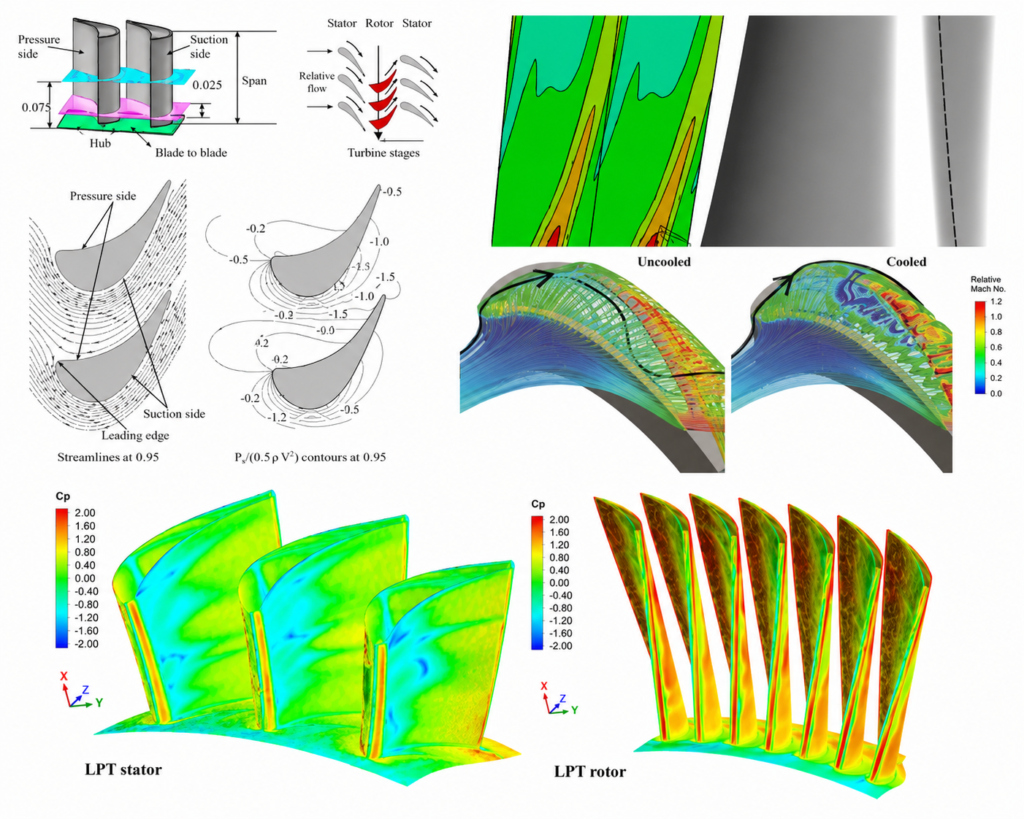
Computational Fluid Dynamics (CFD) analysis enables detailed investigation of complex flow phenomena around turbine blades, including pressure distribution, boundary layer development, secondary flows, flow separation, and wake interactions. Through advanced CFD simulations, RIA GULF supports turbine manufacturers, power generation companies, and engineering consultants in developing high-performance blade designs for industrial applications.
Introduction to CFD Analysis for Turbine Blade Aerodynamics
Computational Fluid Dynamics (CFD) is a powerful numerical simulation technique used to analyze fluid flow behavior within turbomachinery systems. In turbine blade applications, CFD provides detailed insights into airflow patterns and aerodynamic performance that are difficult to obtain through experimental testing alone.
For turbine blade aerodynamic studies, CFD simulations help evaluate:
- Velocity and pressure distribution across blade surfaces
- Boundary layer development and flow separation
- Aerodynamic losses and efficiency
- Secondary flow structures and vortices
- Blade loading characteristics
- Wake formation and downstream flow behavior
By accurately simulating operating conditions, engineers can optimize blade geometries to maximize performance and reliability.
RIA GULF’s Expertise in Turbine Blade CFD Analysis
RIA GULF provides specialized CFD simulation services for turbine blade aerodynamic modelling across a wide range of turbomachinery applications. With expertise in fluid flow analysis, heat transfer, turbulence modelling, and blade optimization, the company supports clients throughout the design and development process.
RIA GULF’s CFD studies assist engineers in:
- Improving turbine efficiency
- Reducing aerodynamic losses
- Optimizing blade profiles
- Enhancing flow uniformity
- Evaluating new blade concepts
- Supporting product development and validation
These simulations provide valuable engineering insights that contribute to improved turbine performance and operational reliability.
Optimizing Turbine Blade Aerodynamic Performance
The aerodynamic characteristics of turbine blades significantly affect energy conversion efficiency. Even small improvements in blade design can result in substantial gains in power generation and fuel efficiency.
Through detailed CFD simulations, RIA GULF evaluates:
- Blade profile performance
- Pressure-side and suction-side flow behavior
- Incidence angle effects
- Flow separation regions
- Tip leakage flow phenomena
- Aerodynamic loading distributions
These analyses help identify opportunities for design improvements and performance enhancement.
Supporting Advanced Turbomachinery Design
Modern turbine systems require sophisticated blade geometries capable of operating under high-speed and high-temperature conditions. CFD analysis enables engineers to investigate complex flow interactions and validate design concepts before manufacturing.
RIA GULF supports the design of:
- Gas turbine blades
- Steam turbine blades
- Compressor blades and vanes
- Stator and rotor blade rows
- High-pressure turbine stages
- Intermediate and low-pressure turbine stages
By analyzing multiple design alternatives, engineers can select the most efficient and reliable configuration.
Performance Validation and Design Optimization
CFD simulations provide a cost-effective method for validating turbine blade designs and optimizing performance under various operating conditions.
RIA GULF performs detailed assessments of:
- Aerodynamic efficiency
- Pressure ratio performance
- Flow uniformity
- Stage loading characteristics
- Blade-to-blade flow interactions
- Off-design operating conditions
These studies help manufacturers reduce development costs while accelerating the design process.
Improving Turbine Efficiency Through Advanced Simulation
Advanced CFD modelling allows engineers to visualize complex flow structures and gain deeper understanding of aerodynamic behavior within turbine stages. This enables the development of blade designs that minimize losses and maximize energy extraction.
By combining advanced CFD techniques with turbomachinery engineering expertise, RIA GULF helps clients develop innovative turbine blade solutions that improve efficiency, increase operational performance, and support the next generation of high-performance turbomachinery systems.