Turbine Exhaust Casing Aerodynamic Analysis and Optimization
CFD Analysis Services for Turbine Exhaust Casing Aerodynamic Analysis and Optimization
The turbine exhaust casing plays a critical role in the overall performance of steam and gas turbines by directing the exhaust flow from the final turbine stages to the condenser or downstream system. Inefficient exhaust casing designs can lead to pressure losses, flow separation, non-uniform velocity distributions, and reduced turbine efficiency.
Computational Fluid Dynamics (CFD) analysis enables detailed investigation of complex flow behavior within turbine exhaust systems, allowing engineers to optimize casing geometry, improve flow distribution, and minimize aerodynamic losses. Through advanced CFD simulations, RIA GULF supports turbine manufacturers, power plant operators, and engineering consultants in enhancing exhaust system performance and improving overall turbine efficiency.
Introduction to CFD Analysis for Turbine Exhaust Casings
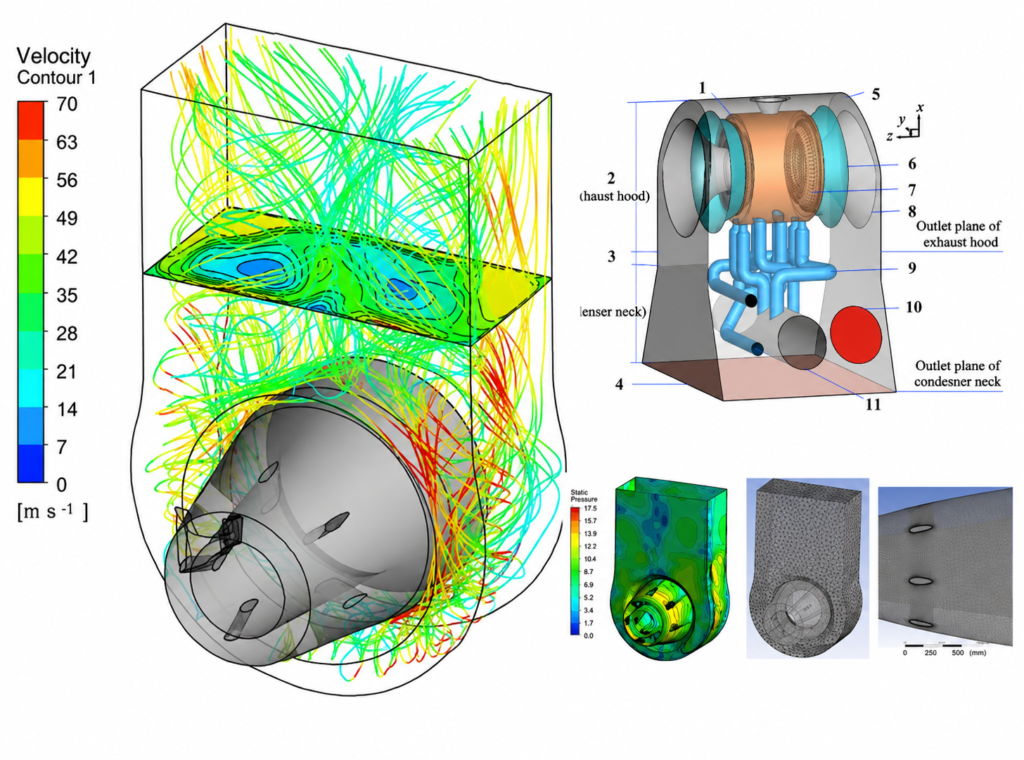
Computational Fluid Dynamics (CFD) is a powerful numerical simulation tool used to evaluate fluid flow behavior within complex engineering systems. In turbine exhaust applications, CFD provides detailed insights into the interaction between high-velocity exhaust flows and exhaust casing geometries.
CFD simulations help evaluate:
- Velocity distribution throughout the exhaust casing
- Static pressure recovery performance
- Flow separation and recirculation zones
- Turbulence intensity and energy losses
- Flow uniformity at condenser inlet locations
- Aerodynamic losses within exhaust hoods
By accurately simulating operating conditions, engineers can identify performance limitations and optimize exhaust casing designs.
RIA GULF’s Expertise in Turbine Exhaust Aerodynamic Analysis
RIA GULF provides specialized CFD simulation services for turbine exhaust casing and exhaust hood aerodynamic analysis. With expertise in turbomachinery flow modeling, pressure recovery optimization, and complex internal flow simulations, the company supports clients throughout the design and performance improvement process.
Our CFD studies assist engineers in:
- Reducing exhaust pressure losses
- Improving turbine back-pressure performance
- Enhancing pressure recovery
- Optimizing exhaust hood geometry
- Improving condenser flow distribution
- Supporting new exhaust system designs
These analyses provide valuable engineering insights that contribute to increased power output and improved operational efficiency.
Optimizing Exhaust Hood and Casing Performance
The aerodynamic characteristics of turbine exhaust systems significantly influence overall turbine performance. Poor flow management within the exhaust casing can result in energy losses and reduced pressure recovery.
Through detailed CFD simulations, RIA GULF evaluates:
- Exhaust flow path performance
- Internal recirculation regions
- Velocity non-uniformity
- Flow turning effectiveness
- Diffuser performance
- Pressure recovery characteristics
These studies help identify opportunities for design modifications that improve exhaust system efficiency.
Flow Distribution and Pressure Recovery Analysis
Efficient pressure recovery is essential for maximizing turbine output and minimizing energy losses. CFD analysis enables engineers to understand complex flow structures and optimize the exhaust casing accordingly.
RIA GULF performs detailed assessments of:
- Static pressure distribution
- Velocity profiles at outlet sections
- Flow separation control
- Diffuser geometry optimization
- Exhaust hood flow behavior
- Condenser inlet flow distribution
These analyses help achieve improved pressure recovery and enhanced system performance.
Supporting Turbine Performance Improvement
Advanced CFD simulations allow engineers to evaluate multiple design alternatives before implementation, reducing development costs and minimizing performance risks.
RIA GULF supports:
- Steam turbine exhaust systems
- Gas turbine exhaust systems
- Exhaust hoods and diffusers
- Condenser inlet optimization
- Retrofit performance studies
- New turbomachinery development projects
By analyzing flow behavior under various operating conditions, engineers can develop optimized exhaust systems that improve reliability and efficiency.
Enhancing Turbine Efficiency Through Advanced Simulation
Modern turbine systems require highly efficient exhaust flow management to maximize energy conversion and power generation. CFD analysis provides a cost-effective method for understanding flow behavior and identifying performance improvement opportunities.
By combining advanced CFD modelling with turbomachinery engineering expertise, RIA GULF helps clients optimize turbine exhaust casing designs, reduce aerodynamic losses, improve pressure recovery, and achieve higher overall turbine performance.