Low-Pressure Turbine Aerodynamic Design and Diffuser Optimization
CFD Analysis Services for Low-Pressure Turbine Blade and Diffuser Aerodynamic Modelling
Low-pressure turbine (LPT) stages play a critical role in maximizing energy extraction and improving the overall efficiency of steam and gas turbines. The aerodynamic performance of LPT blades and diffuser systems directly influences pressure recovery, flow stability, and turbine efficiency.
Computational Fluid Dynamics (CFD) analysis enables detailed evaluation of complex flow behavior within low-pressure turbine stages, helping engineers optimize blade geometries, diffuser configurations, and flow paths for enhanced performance. Through advanced CFD simulations, RIA GULF supports turbomachinery designers, power generation companies, and engineering consultants in developing highly efficient turbine systems.
Introduction to CFD Analysis for Low-Pressure Turbine Aerodynamics
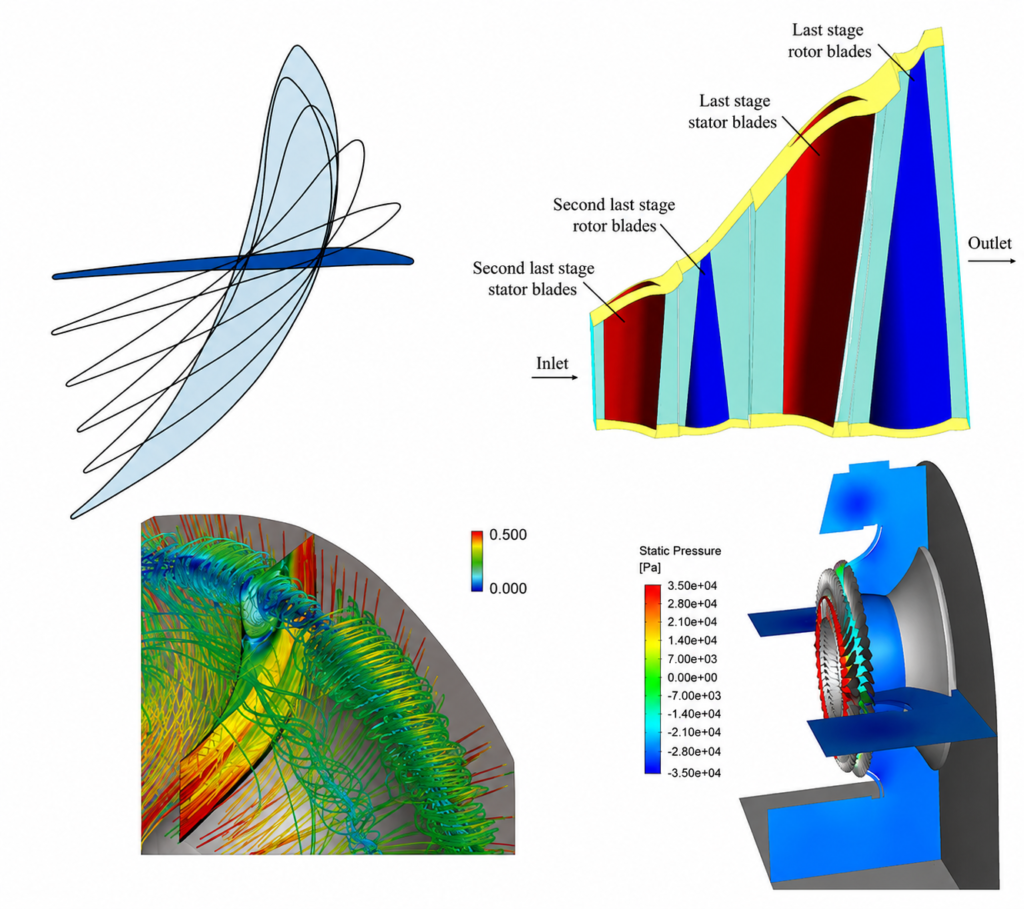
Computational Fluid Dynamics (CFD) is a powerful simulation tool used to analyze airflow behavior, pressure distribution, and energy losses within turbine stages. For low-pressure turbines, CFD provides detailed insights into aerodynamic phenomena that significantly impact performance.
CFD simulations help evaluate:
- Blade loading and pressure distribution
- Flow separation and reattachment
- Secondary flow structures
- Wake formation and interaction
- Diffuser pressure recovery
- Aerodynamic efficiency and losses
These analyses allow engineers to improve turbine stage performance while reducing aerodynamic losses.
RIA GULF’s Expertise in LPT and Diffuser CFD Analysis
RIA GULF provides specialized CFD simulation services for low-pressure turbine blade and diffuser aerodynamic modelling. Using advanced numerical techniques and industry-standard CFD tools, the company assists clients in optimizing turbomachinery components for improved efficiency and reliability.
Our CFD studies support:
- Steam turbine blade design
- Low-pressure turbine optimization
- Diffuser flow analysis
- Pressure recovery enhancement
- Turbine stage performance evaluation
- New blade profile development
The simulations provide valuable engineering insights that help improve turbine operation and energy conversion efficiency.
Optimizing Low-Pressure Turbine Blade Performance
The aerodynamic characteristics of low-pressure turbine blades have a significant influence on stage efficiency. Even minor improvements in blade geometry can produce measurable gains in turbine performance.
Through detailed CFD simulations, RIA GULF evaluates:
- Pressure-side and suction-side flow behavior
- Blade profile optimization
- Flow acceleration and deceleration regions
- Boundary layer development
- Flow separation zones
- Aerodynamic loss mechanisms
These studies help identify opportunities for improving turbine efficiency and operational performance.
Diffuser Flow Path and Pressure Recovery Analysis
The diffuser section downstream of the turbine stage plays an important role in recovering static pressure and minimizing energy losses. Improper diffuser design can lead to flow separation and reduced performance.
RIA GULF performs CFD analyses to assess:
- Diffuser pressure recovery
- Flow uniformity
- Velocity distribution
- Back-wall geometry effects
- Flow path optimization
- Separation control strategies
By optimizing diffuser geometry, engineers can achieve improved pressure recovery and enhanced overall turbine efficiency.
Performance Enhancement Through Advanced Simulation
Advanced CFD modelling enables engineers to visualize complex flow structures and evaluate multiple design alternatives before manufacturing or implementation.
RIA GULF helps clients:
- Improve turbine efficiency
- Reduce aerodynamic losses
- Enhance pressure recovery
- Optimize blade and diffuser geometries
- Validate innovative design concepts
- Support next-generation turbomachinery development
Through comprehensive aerodynamic analysis, RIA GULF delivers engineering solutions that contribute to higher efficiency, improved reliability, and superior turbomachinery performance.