CFD ANALYSIS FOR WAREHOUSE FIRE ANALYSIS
CFD Analysis Services for Warehouse Fire Analysis: Enhancing Fire Safety and Smoke Management
Warehouses and large storage facilities contain significant quantities of materials and goods that can contribute to rapid fire growth if an ignition occurs. Due to the large open spaces, high storage racks, and complex layouts, fires in warehouses can generate substantial heat and smoke, posing serious risks to occupants, assets, and emergency responders.
Computational Fluid Dynamics (CFD) analysis provides an advanced engineering approach to study fire dynamics, smoke movement, and heat transfer within warehouse environments. Through detailed CFD simulations, RIA GULF helps engineers and fire safety consultants evaluate fire scenarios, assess smoke control strategies, and develop safer warehouse designs.
Introduction to CFD Analysis for Warehouse Fire Scenarios
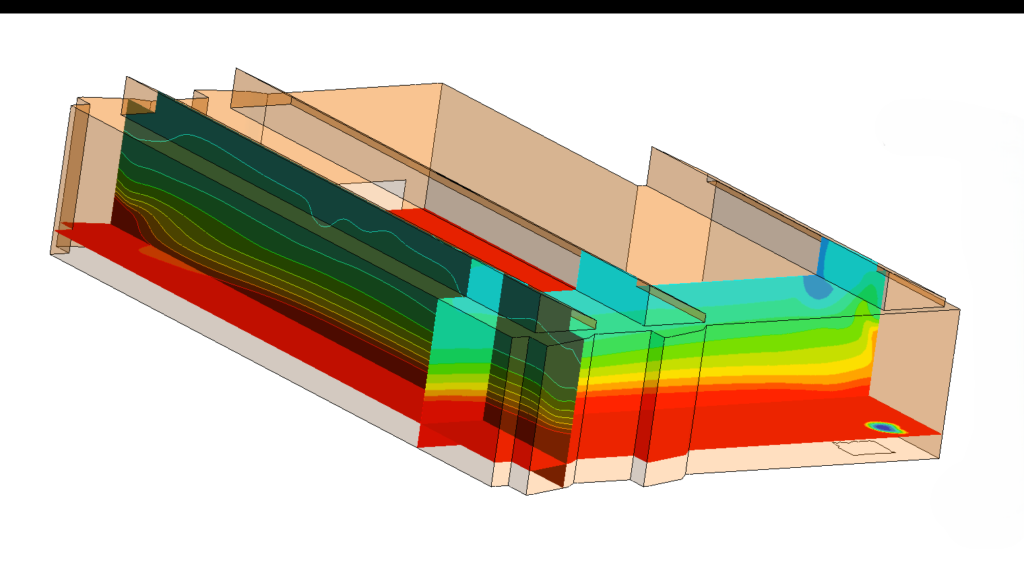
Computational Fluid Dynamics (CFD) is a powerful numerical simulation technique used to model fluid flow, heat transfer, and gas movement in complex environments. In fire safety engineering, CFD simulations are widely used to analyze the behavior of smoke, heat, and combustion gases during fire events.
For warehouse fire analysis, CFD simulations help engineers evaluate:
Fire growth and heat release behavior
Smoke propagation and accumulation patterns
Temperature distribution within the facility
Airflow interaction with smoke movement
Effectiveness of smoke ventilation systems
By simulating realistic fire scenarios, engineers can better understand how fires behave in large warehouse spaces and identify measures to improve safety.
RIA GULF’s Expertise in Fire and Smoke CFD Analysis
RIA GULF provides specialized CFD simulation services for fire safety analysis in industrial and commercial buildings. With strong expertise in fire dynamics, fluid mechanics, heat transfer modeling, and smoke movement analysis, the company supports architects, safety engineers, and facility operators in developing effective fire protection strategies.
RIA GULF’s CFD studies provide valuable insights that help improve warehouse safety while supporting performance-based fire engineering design.
Evaluating Smoke Movement and Ventilation Performance
Smoke generated during warehouse fires can spread rapidly across large spaces and obstruct visibility, making evacuation and firefighting operations more difficult. Proper smoke control and ventilation systems are therefore essential for maintaining safer conditions during fire events.
Using CFD simulations, RIA GULF evaluates:
Smoke layer development and spread
Effectiveness of smoke exhaust systems
Interaction between smoke and ventilation airflow
Smoke movement around storage racks and structural elements
Influence of building geometry on smoke distribution
These analyses help engineers optimize smoke ventilation strategies and improve fire safety design.
Supporting Safe Evacuation and Firefighter Access
Maintaining safe evacuation conditions is one of the most critical objectives of fire safety design in warehouses. CFD simulations provide valuable information about how smoke and heat affect occupant safety during fire events.
RIA GULF conducts CFD studies to assess:
Visibility conditions along evacuation routes
Temperature levels at occupant height
Smoke layer height within warehouse spaces
Available safe evacuation time (ASET)
These insights help engineers develop design strategies that improve occupant safety and assist emergency responders during firefighting operations.
Assessing Fire Protection and Smoke Control Strategies
CFD analysis allows engineers to evaluate the effectiveness of fire protection systems and smoke management strategies before implementation.
Through advanced simulations, RIA GULF helps evaluate:
Natural and mechanical smoke ventilation systems
Roof smoke vents and exhaust fans
Fire compartmentation strategies
Interaction between fire suppression systems and smoke movement
These analyses enable project teams to select the most effective fire safety solutions for warehouse facilities.
Improving Warehouse Safety Through Advanced Simulation
By combining advanced CFD modeling techniques with fire engineering expertise, RIA GULF helps designers and facility operators improve fire safety in warehouse environments.
Through detailed simulation of fire growth, smoke propagation, and ventilation performance, engineers can evaluate multiple design scenarios, identify potential safety risks, and implement optimized fire protection strategies that enhance the resilience of warehouse facilities.