CFD ANALYSIS FOR THERMAL COMFORT
CFD Analysis Services for Thermal Comfort: Optimizing Indoor Environmental Quality
Thermal comfort is a critical factor in the design and operation of modern buildings. Whether in commercial offices, residential complexes, shopping malls, industrial facilities, or public spaces, maintaining a comfortable indoor environment is essential for occupant well-being, productivity, and energy efficiency.
Computational Fluid Dynamics (CFD) analysis provides an advanced engineering approach to evaluate airflow distribution, temperature variation, and ventilation performance within indoor environments. Through detailed CFD simulations, RIA GULF helps engineers and building designers assess thermal comfort conditions and optimize HVAC system performance to create healthier and more comfortable indoor spaces.
Introduction to CFD Analysis for Thermal Comfort
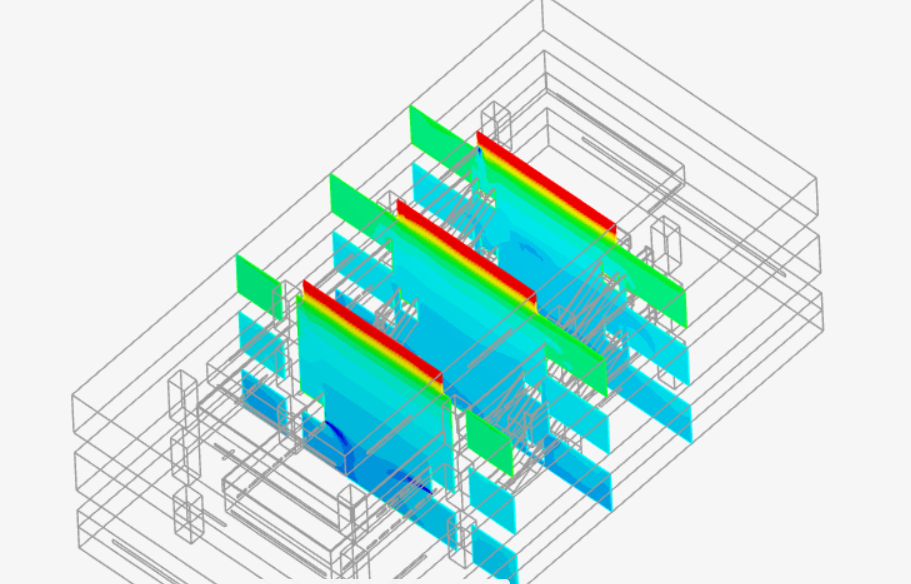
Computational Fluid Dynamics (CFD) is a powerful numerical simulation technique used to study fluid flow, heat transfer, and air movement within complex environments.
In thermal comfort analysis, CFD simulations allow engineers to evaluate how air moves within indoor spaces and how temperature and ventilation conditions affect occupants. These simulations help analyze important parameters such as:
Airflow distribution within indoor environments
Temperature variations across occupied zones
Air velocity at occupant level
Effectiveness of HVAC systems
Interaction between supply air and room airflow
By accurately modeling these factors, engineers can identify areas of poor ventilation, temperature stratification, or discomfort and implement design improvements.
RIA GULF’s Expertise in Thermal Comfort CFD Analysis
RIA GULF provides specialized CFD simulation services to support the design and optimization of indoor environmental conditions. With strong expertise in fluid dynamics, heat transfer, HVAC airflow modeling, and building ventilation analysis, the company assists architects, mechanical engineers, and building consultants in evaluating thermal comfort performance.
Through advanced CFD studies, RIA GULF helps project teams ensure that indoor environments provide comfortable and healthy conditions for occupants.
Optimizing HVAC System Performance
Heating, ventilation, and air conditioning (HVAC) systems play a crucial role in maintaining thermal comfort in buildings. However, improper airflow distribution or poor diffuser placement can result in uneven temperature conditions and inefficient cooling or heating.
Using CFD simulations, RIA GULF evaluates:
Air supply diffuser placement and airflow patterns
Temperature distribution within occupied zones
Air velocity at occupant height
Effectiveness of return air systems
Potential areas of air stagnation or excessive airflow
These insights allow engineers to optimize HVAC system design and improve the overall efficiency of building ventilation systems.
Evaluating Occupant Comfort Conditions
Thermal comfort depends on several environmental factors including air temperature, air velocity, humidity, and radiant heat exchange. CFD simulations provide detailed information about these parameters within indoor spaces.
RIA GULF conducts CFD studies to assess:
Temperature conditions within occupied areas
Air velocity experienced by occupants
Thermal stratification within large spaces
Interaction between indoor airflow and heat sources
These analyses help ensure that indoor environments meet recommended comfort standards for occupants.
Supporting Energy-Efficient Building Design
Optimizing airflow and temperature distribution not only improves occupant comfort but also enhances the energy efficiency of HVAC systems. Poor airflow management can lead to excessive cooling or heating requirements, increasing energy consumption.
CFD analysis performed by RIA GULF helps building designers:
Improve HVAC efficiency through optimized airflow design
Reduce energy consumption in cooling and heating systems
Identify areas of overcooling or undercooling
Enhance overall building energy performance
These improvements support sustainable building design and reduce long-term operational costs.
Enhancing Indoor Environments Through Advanced Simulation
By combining advanced CFD modeling techniques with expertise in HVAC and building ventilation systems, RIA GULF helps designers create indoor environments that provide both comfort and efficiency.
Through detailed airflow and thermal simulations, engineers can evaluate multiple design configurations, optimize ventilation strategies, and ensure that buildings maintain comfortable conditions for occupants throughout the year.